
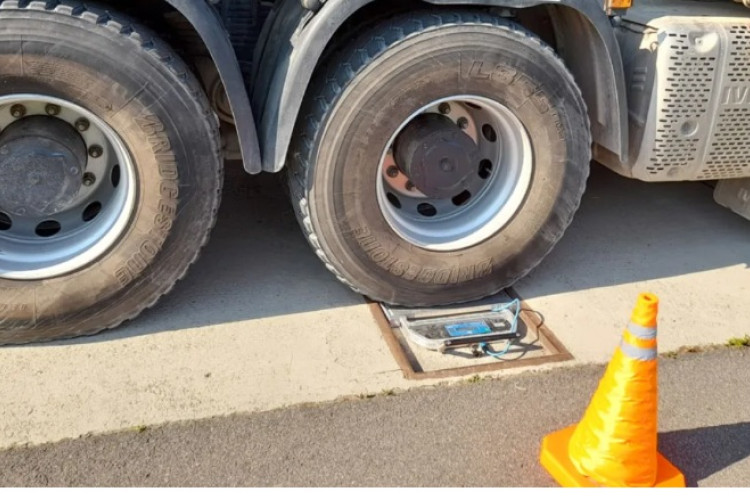
Penalties for vehicle overloading in Europe depend on the country, the permissible gross vehicle weight (GVW), and the extent to which the limits are exceeded. In addition to fines, authorities often order the immediate unloading of excess cargo or impound the vehicle. Usually the party responsible for the overloading is the carrier, but in certain situations the freight forwarder may also be held liable.
Vehicle overloading occurs when the gross vehicle weight (GVW) is exceeded or when the load on one of the vehicle’s axles exceeds the limit specified in its technical specifications. Therefore, it is not only the weight of the cargo that matters, but also how it is distributed.
Penalties for vehicle overloading in Poland
Overloading detected during an inspection results in fines, which in Poland are as follows:
Overloading a vehicle with a GVW of 2.5–3.5 t: from approx. €115 to €460.
Overloading a vehicle with a GVW of 3.5 to 12 t: from approx. €115 to €1,145.
Overloading a vehicle with a GVW over 12 t: approx. €230 to €2,290.
In the case of vehicles operating without a permit or abnormal load vehicles, the fine for overloading can reach approx. €3,430.
Any vehicle found to be overloaded may be towed to a holding compound and impounded if it is not possible to transfer part of the goods to another vehicle.
Penalties for vehicle overloading in Europe
Germany In this country, compliance with vehicle weight regulations is monitored by the BAG (Bundesamt für Güterverkehr), which, like the ITD in Poland, does not define a minimum excess threshold for GVW or axle load. In practice, however, if the overload does not exceed 2%, the penalty may be replaced with a far less severe warning. Conversely, if the authorities deem the violation significant, they will issue a fine to the carrier ranging from €30 for minor infringements (a 2.5% overload) to €435 when the overload exceeds 35% of the permissible weight or axle load. In the case of a vehicle overload in Germany, the driver will also be fined.
Austria Vehicle overloading is monitored by inspectors from the Federal Transport Authority or the Department of the Federal Ministry for Transport, Innovation and Technology. In Austria, overloading of up to 5% of the permissible vehicle weight results in a €10 fine. The maximum fine, for an excess of 35% or more, is €235. The fine will be paid by the driver as well as by the carrier or the entity acting as the transport organiser.
The Netherlands Vehicle weight checks are carried out by the Inspectie Verkeer en Waterstaat (IVW), and the penalty thresholds are relatively liberal. A fine for exceeding the vehicle weight will be issued if the excess reaches at least 5%, and in the case of axle overload, 10% of the permissible value. However, if that threshold is reached, the fines are among the highest in Europe, ranging from €360 to €2,800 in the case of vehicle overload and starting at €360 in the case of axle overload.
France Vehicle overloading is inspected by DREAL (Directions Régionales de l’Environnement, de l’Aménagement et du Logement) and law enforcement officials – Gendarmerie Nationale and Police Nationale.
Vehicle overload penalties start at €135 for minor overloads and go up to €1,890. When it comes to axle overload, the fine is €135 for every 300 kg (or part thereof) on the axle.
Who is liable for vehicle overloading?
The carrier and the driver Liability for vehicle overloading generally rests with the carrier, although in certain cases the driver may also receive a fine. Polish regulations stipulate that the penalty may fall on the driver if the carrier is able to prove that the driver is at fault for the overloading. In France, fines are issued to all liable parties, including not only the carrier and the driver (who is obliged to check the vehicle weight), but also the shipper, if he provides false weight declarations.
The freight forwarder A freight forwarder may suffer the consequences of vehicle overloading primarily when listed as the consignor of the goods in the transport order. Pursuant to Article 7(1) of the CMR Convention, the consignor is liable for the accuracy of the details in the consignment note, and the carrier is not obliged to weigh the cargo unless instructed to do so.
A freight forwarder assumes the status of consignor if they set the transport conditions based on the contract of carriage (often an accepted transport order), such as the freight rate, type of cargo, place of loading and unloading, and delivery deadline.
The transport order placed by the freight forwarder may also serve as a basis for imposing a penalty if its terms confirm that the cargo weight does indeed exceed standard limits. In a direct dispute, however, the freight forwarder’s liability in such a situation can be debatable, as demonstrated by a case study from Poland in which a forwarder held liable by a court of first instance avoided the penalty following a successful appeal.
Different rules may apply in different countries – France is a good example. Under French law, if a freight forwarder pays an “abusively low price” (prix abusivement bas) that logistically forces or incentivizes the carrier to overload the vehicle to break even, he is hit with a 5th-class fine of up to €1,500.
How to minimise the risk of being held liable for vehicle overloading? A freight forwarder acting in the capacity of consignor must expect a broader scope of liability for potential overloading. He should keep in mind that the cargo weight stated in the documentation must comply with the regulations. If the declared weight exceeds the permissible limits and the freight forwarder contracts such transport, it will face consequences during an inspection.
It is in the freight forwarder’s interest to oblige the carrier to verify that the declared loading weight matches reality, in order to avoid irregularities. To avoid exceeding the load limit on a specific vehicle axle, transport documents and orders must specify the weight of individual transport units, such as pallets, while the carrier should participate in the loading and monitor how the pallets are distributed within the vehicle.


